
Home Services Pocket Gopher Control in Brighton, CO
Pocket Gopher Control in Brighton, CO
Pocket gophers are solitary, stubborn, and very good at what they do. We find their tunnels and take them out — that's the whole job.
Looking for gopher control Brighton CO? Call (720) 764-0432 and we'll talk through your situation.
Why gophers are hard to get rid of
The plains pocket gopher lives almost entirely underground in a tunnel system it digs, maintains, and defends alone. It rarely comes above the surface, so anything aimed at what you can see — repellent plants, ultrasonic stakes, home remedies — has no documented effect on it.
Each burrow system holds one animal, so there's no colony to knock down with a single treatment. Every gopher has to be caught individually. And because empty tunnels get claimed by newcomers, populations can bounce back within a year if nobody's watching. Control that works accepts all of that and deals with the tunnels directly.
How we do it
First visit: we read the mounds. Fresh, fan-shaped piles with plugged tunnels tell us where the digging is active right now. We probe for the main tunnel — usually a foot or so out from the mound plug — and set traps facing both directions in the run.
Then we come back on a schedule, clear every animal, and collapse the worked tunnels. Spring and fall, when tunneling is heaviest, are the most productive windows — but gophers dig year-round in irrigated ground, so there's no bad time to start.
What it costs you in damage
It's not just the lawn. Gopher tunnels divert irrigation water, chew through drip lines, and undermine ditch banks. Roots and tubers get eaten from below, which is how garden rows go bare and young trees stall out. On Brighton's sandy soils near the South Platte, a busy gopher can move an astonishing amount of dirt in a season — one animal, hundreds of mounds.
Signs you have pocket gophers
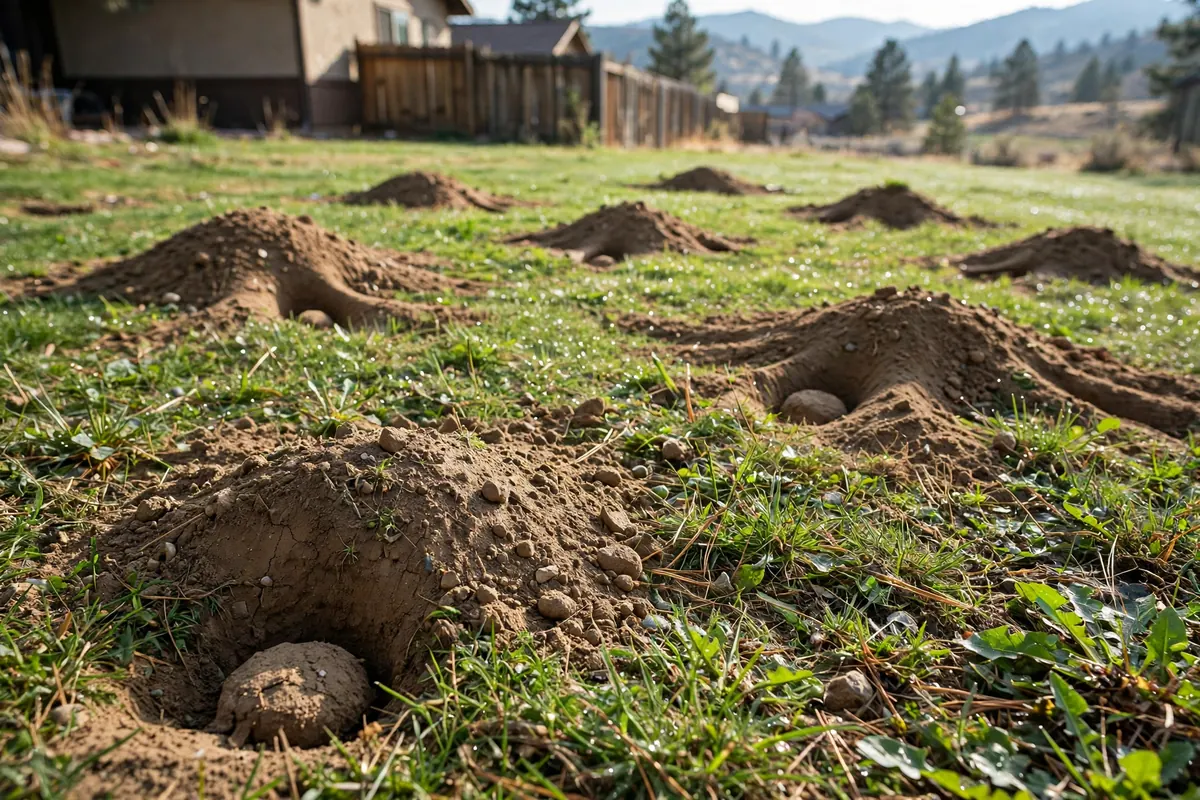
The mounds tell the story. Pocket gopher mounds are fan-shaped or crescent-shaped piles of loose soil with no visible hole — the gopher plugs the tunnel entrance with dirt after pushing the soil out. Fresh mounds are dark and moist; older ones dry out and turn pale, so you can read how recent the digging is. Several mounds in a rough line usually mark the path of a main tunnel run.
Secondary signs back it up: plants wilting for no clear reason (roots eaten from below), irrigation water disappearing into the ground faster than it should, and soft or spongy spots when you walk the lawn. Voles leave surface runways in the grass instead of mounds, and moles build cone-shaped volcano mounds — around Brighton, the fan-shaped piles are almost always gophers.
What happens on the first visit
We walk the property and read the ground before touching anything. Fresh mounds get flagged, old inactive ones get noted and ignored. Then we probe: a long metal probe pushed into the soil near the freshest mounds drops suddenly when it hits the main tunnel — usually 6 to 12 inches down. That tells us exactly where to set traps, and how many tunnel systems are active.
Traps go into the main runs facing both directions, get staked so nothing drags them off, and get flagged so you know where they are. We'll tell you straight how many systems we found and what the job looks like — no upsell, just the read. Most Brighton yards take one setting visit plus one or two follow-ups.
After the gophers are gone
Clearing the animals is the middle of the job, not the end. We collapse the worked tunnels and level the mounds so the surface is readable again — that's how you (and we) can tell if new digging starts. On the follow-up visit we check every flagged spot for fresh activity before calling it done.
For the long term, it depends on the property. Open ground next to fields or ditches means reinvasion pressure, and we'll say so honestly. Gardens and new plantings get the most protection from buried exclusion barriers — wire in the ground outlasts any trapping program. For plain lawns, the practical answer is periodic checks in spring and fall when tunneling peaks.
Questions about pocket gopher control in brighton, co
How much does gopher control cost?
Every property is different — size, mound count, and how long they've been digging all matter. Call and describe what you're seeing and we'll give you a straight answer about what the job involves.
Do I have gophers or moles?
Fan-shaped mounds with no visible hole mean pocket gophers; cone-shaped volcano-like mounds mean moles. Around Brighton, gophers are far more common. If you're unsure, send us a photo of the mounds when you call.
Will one treatment permanently solve it?
It solves the current animals. But gophers reinvade — new ones find empty tunnels. We check for fresh activity after the first pass, and for high-value spots like gardens we recommend exclusion barriers so the fix lasts.
How many gophers do I actually have?
You can't tell from mound count — one gopher builds dozens or hundreds of mounds. We find out by trapping: each animal gets caught individually, so the number becomes clear as the job progresses. A typical Brighton yard holds two to five.
Do gophers hibernate in winter?
No. Pocket gophers stay active underground all winter in Colorado. Tunneling slows when the ground freezes hard, but under snow cover they're insulated and protected from predators, so winter digging continues — you'll just see the evidence when the snow melts.
Can I just flood the tunnels out?
It doesn't work. Gopher tunnels drain fast in sandy soil, and the animal simply plugs off the flooded section and keeps digging. All you'd do is waste water — a real concern with irrigation schedules — while the gopher carries on underneath.
Ready to deal with the pocket gopher control in brighton, co?
Call Brighton Gopher Pros at (720) 764-0432 — we'll find the tunnels and handle the rest.